Friday, 8 May 2015

Hydraulic Pumps

Hydraulic pump is a mechanical device which is used to converts the mechanical power of the system into hydraulic energy. To overcome the pressure which is induced by the load hydraulic pump generates high power flow.

A hydraulic pump performs basic two functions when it operates:
  • A mechanical action which creates a vacuum at the pump inlet, it permits atmospheric pressure to force liquid from the reservoir into the inlet line to the pump.
  • The second function which is performed its mechanical action that delivers liquid to the pump outlet and then forces it into the hydraulic system.

Why we need Hydraulic Pumps?

We need hydraulic pumps because they are the main sources of power for different dynamic machines. Hydraulic pumps have the power to push large amount of oil through the hydraulic motors and cylinders. In returns, the pump converts the mechanical work of energy into the hydro static energy.

Principle on which Hydraulic pumps operates

According to the displacement principle the hydraulic pump operates. In this principle the existed mechanically sealed chambers in the pump may involves. The purpose of these chambers is to transport the fluid from suction port (inlet) of the pump to the pressure port (outlet). These sealed chambers also ensure that no direct connection between the inlet and outlet port of the pump. This is the main reason that these pump suitable to operate at very high pressure and they are also ideal for Hydraulic systems. The mechanism of pump is shown in the figure below:
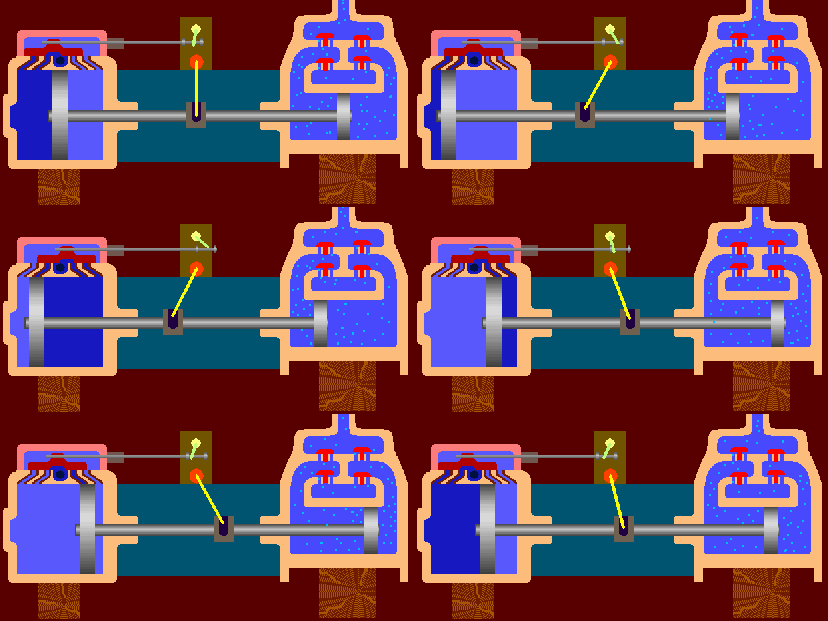

Mechanism of a pump

Types of Hydraulic Pumps

Depending on their different functional and other system requirements such as range of pressure or flow, operating medium, type of drive etc. hydraulic pumps are manufactured. Hydraulic pumps may have large range of design principle and configurations. All pumps can’t fully meet the requirements of the system. So for that reason different types of hydraulic pumps exists which are given below:

Hydraulic Gear Pumps

External gear pump
Internal gear pump
Gear ring pump
Screw spindle pump

Hydraulic Vane Pumps

Single chamber vane pump
Double chamber vane pump

Hydraulic Piston Pumps

Axial piston pump
Radial piston pump

Uses of Hydraulic Pumps

Hydraulic pumps are used in hydraulic machines. While selecting a hydraulic pump it must have good frequency, pressure and temperature capabilities. Hydraulic pumps are used to do different type of works such as open, close, lower and to lift components.They are also used in field services like machining and assortment of construction

A pump produces liquid flow or movement which is necessary for the development of pressure. This is a function of resistance to fluid flow in the system. For example, the pressure of the fluid at the pump outlet is zero for a pump not connected to a system (load). Further, to overcome the resistance of the load, pressure will rise to the level for a pump delivering into the system.


For more information about field services and hydraulics machines you can visit http://millenniumind.com/

Thursday, 7 May 2015

Shielded Metal Arc Welding (SMAW)

SMAW is a process of welding that uses a fragile electrode coated in flux. SMAW have many names this process is also known as stick welding, Manual Arc Welding or flux shielded arc welding. In SMAW process as the weld is laid, the external coating of flux on electrode disintegrates, providing a layer of slag and a shielding gas. These elements protect the weld area from infectivity until the area cools. The external flux coating also performs more functions such as it provides control bead shape or arc stability.

Equipment & Operation for SMAW

The following equipment and operations are necessary for SMAW process.
  • Welding power source
  •  Electrode holder
  • Ground clamp
  • Welding cables and connectors
  • Accessory equipment (It includes wire brush, chipping hammer)
  • Protective equipment (It includes gloves, helmet etc.)

Welding Power Sources

Shielded Metal Arc Welding circuit we can use either Direct Current (DC) or either Alternating Current. In some specific cases, the power source must use constant current type. In this type, power source will deliver relative welding current or constant amperage. As it will remains constant so the weld beads which are produced will be uniform in shape and size.


Electrode Holder

The use of electrode holder is to connect different welding cables and ducts to the electrode. Electrode holder is available in different sizes and capacities. The purpose of insulated handle is to guide electrode over the weld joints.

Ground Clamp

The purpose of the ground clamp is to connect the ground cable to the work piece. A good ground clamp having the characteristics of carrying more electric current without overheating.

Welding cables and connectors

Electrode cable and ground cable plays an important role in the SMAW circuit. So different welding cables and connectors are also necessary components for the SMAW circuit.

Coated Electrodes

In Shielded Metal Arc Welding various types of coated electrodes are used. For different types of welding specific electrodes are used according to their types. For example, electrodes used for low allows and stainless steels will quite different from the coated electrodes which are used for mild or carbon steel.

For information about the Fabrication or welding you can also visit http://millenniumind.com/

Tuesday, 5 May 2015

Welding Repair

Weld repair is a process in which remove the damages of a metal. Metal damages removes from the use of Oxy fuel welding and by using carbon arc gouging or plasma cutting. For a good metal weld repair we must follow the steps which are involves in weld repair process.

Welding Procedure

For the use of welders a logical procedure of welding is to be applicable. In this procedure use special metal fillers and preheat the metal. In most of the construction companies, we can successfully weld a steel metal by using the following three steps which are:

  •  In first step, Cutting the metal into the parts and removed the defected Components.
  • In second step, prepare the new metal weld joints
  • In third step, welding and cleaning the metal.

Step 1: Cutting metal into the parts and removed the defected components.

In the first step of welding repair removes the damages of a metal. This step can complete with the use of different welding techniques. Plasma and oxy-fuel are used for cutting a metal. We can also use carbon arc gouging which is well suited for removes the cracks from metal without harming the other parts of a metal.
With the help of different tools we can repair a metal. One of the most commonly used for cutting a metal is Oxy-fuel torch. Another tool which is used for cutting a metal is plasma cutters. By using plasma cutters welders can cut small parts width of metals. Plasma cutters are faster than the Oxy-fuel torches because by using plasma cutter welders can also cut electrical conductive metals but with the use of oxy-fuel torch welders can’t cut the stainless steel or aluminum metals. One of the most other common tools is carbon arc gouging which is used for welding generators. In using a carbon arc gouging uses an electrode which is made up of a carbon. By using this electrode welder can remove the defected parts. In result high pressure stream of air will released.

Step 2: prepare the new metal weld joints.

In the second step, welder will choose the filler material and replace all the parts with selected material which is better and have more power strength of the previous original material. According to their different mechanical properties such as tensile strength, wear resistance and ductility etc they have different applications. For avoiding long term failure of welding must ensure the quality and remove the unwanted downtime defects. When you will choose the right alloy then cut the steel and bevel the edges. After this preheating is required this is to be done by the use of oxy fuel torch.

Step 3: Welding and cleaning the metal.

In the third and last process, welders choose the welding process which they will follow to weld a metal. There are two most commonly used processes are:
  •            Shielded Metal Arc Welding (SMAW)
  •            Flux Cored Arc Welding (FCAW).


This article is all about the welding repair process. Millenniumind industry will offer the all these services.
For more details you can also visit at http://millenniumind.com


Monday, 4 May 2015

Safety Practices For Fabrication Shop Work

Fires blown up due to welding are avoidable, if workers follow those safeguards & practices prescribed by workshop administration before stepping into it, then precious lives could be saved from loss. 1.4% residential fires & 10% commercial fires reported in Irving – Texas due to welding accidents in 2002. Negligence in preventive measures give rise to such incidents, workers could overcome them by adopting prescribed standards of protection.

It is necessary for welders whether they are professional or unprofessional to know about potential threat of catching fire on fabrication shop, as work at high currents during make and break of connections.

Must do Checkups:
First thing first, before getting into work you should examine:

  • Equipment’s health, 
  • Working & surrounding area, 
  • Available items to minimize hazards and 
  • Measures that can ensure safety.


Checking of Equipment:
In order to avoid any accidents, the installation of the welding equipment should be done by qualified technicians, which can ensure about the connectivity as well as operation of apparatus according to manufacturer’s instructions. However, installed equipment correct operation i.e. cable, electrode holder and coupling devices is verified at welder’s end, he should be competent enough to identify, recover or report about the defects. The welder should make sure each time he uses the equipment, the external connections are clean & tight, clamp of wire has firm grip to grab the workpiece and appropriate distance between welding point & workpiece.

Reduction of Electric Shock Risk:
In arc welding, the major hazard that you might come across is the arc radiation and electric shock, it may occur due to appearance with live parts i.e. electrodes and workpiece of welding circuit. Certified welding shops use proper safety & protection system, as voltage seepage during rainy season increases as compared to normal.

More than One Welding Operations at One Workpiece:
There is a huge risk of electric shock when more than one workpieces have physical or electrical connection. Complete isolation of workpieces should be observed, else it will increase the probability of electrocuted in case of simultaneous connection.

Outdoor Working:
While working outdoor welding repair the possibility of moisture increases, it also increases voltage leakage. In such case, system requires sufficient level of waterproofing, for enclosures the ingress protection (IP) codes should be:

  • IP 23 protection against water spray <60 degrees from vertical
  • IP 24 protection against water spray from any direction

In case of rainfall, welder, equipment & workpiece should have complete protection from moisture.

Some Safety Practices to Avoid Tragic Situations:
The safety practices are as follows:

  • The welders should takeoff ornaments like rings and metallic straps before getting started with work.
  • The clothing like gloves, boots & overalls should be used to protect from electric shock.
  • The external connection of the welding apparatus should be checked on daily basis, whether connections clean and fixed or not.
  • The electrode of manual metal arc welding (MMAW) should have insulation for protection, to change the electrode.
  • High frequency (HF) can make welder feel electric shock, HF could affect even through small hole in glove.


Wednesday, 29 April 2015

What Is CNC Machine, Types & Troubleshooting?

The word CNC is the derivation of NC meaning ‘Numerical Control’, whereas CNC means ‘Computer Numerical Control’. Obviously, CNC is numerically controlled device attached with the element of digital computing. In order to do so, machine tools are controlled by means of computer instructions, which are predetermined to perform each function of machine. Punched Tape is the clear example of machined controlled by computing device.

Overview:
Both NC & CNC enables greater ratio of productivity for tools of machine, as they are automatically controllable and require less human intervention. Before the innovation of CNC, Hydraulic Tracer Systems were less capable of automation element, due to the usage of hydraulics in cutting tools of lathe & template of mill. Moreover, such systems require taper attachments, which were used for many manual lathes indifferently capable of hydraulic tracer, as tracer had greater capability for the elaboration of templates rather than simple tapers.

Classification of CNC Machines:
As CNC involves usage of computers, so it increases the no. of machines, which could be brought under such classification.

  • Retrofitted Machines – The machines that don’t have CNC installed by default or during manufacture.
  • Custom Built Machines – The custom-built machines to perform CNC operation.

Types of CNC Machines:
Here we will mention some of the widely used at industrial level:

Milling Machine:
Milling Machine is used to cut different materials driven by computer controls, which translates programs containing instructions in the form of digits and letters to move the spindle of machine at specified dimensions. The standard programming language of all CNC machines is G code, while some manufacturers use customized propriety languages, which are simpler than standard language & easy in transfer.

Lathe Machine:
Lathe is a retrofitted CNC machine mostly used for cutting metal objects rotating with a fast speed. Basic feature of Lathe Machines is that they are capable to cut the metal by the help of indexable tools & drills with extreme precision in a quick manner that is not possible on manual lathes. Usually machine comprise of twelve tool holders, along with coolant pumps that cut down on tool wear. The field installation & control specification of Lathe Machine is similar to Milling Machine as it allows G code as well as proprietary programming language.

Troubleshooting of CNC Machine:
To troubleshoot a CNC machine, here are the key steps to follow:

  • Environmental Issue: The issue may arise due to increase in temperature. Temperature of machining shop should be maintained with respective measures.
  • Mechanical Issue: The problem may exist in flatbed guideway, ballscrews, & spindles that affect the tools and job under machine.
  • Electrical Issue: At major level, it could be heating of cable, or it could be at miniature level that could be traced by trained CNC engineer through milling machine schematics.

Tuesday, 21 April 2015

Fabrication classes


Fabrication classes
Fabrication classes

Metal fabrication shops includes many processes of producing metal elements by ever-changing the raw metal material exploitation varied tools. The processes are classified as cold, heat and hot operating betting on the temperature at that the fabric is processed. Most of the objects around USA like paper clips, computers, bolts, nails, automobile components, components used for instruments and machinery and myriad alternative merchandise are remodeled by metal fabrication processes like bending, punching, drilling, turning, grinding, threading etc. The factors influencing the method enclosed the kind of fabric being machined, the speed of production, the specified pure mathematics, and alternative physical needs of the half.

Fabrication is divided into the subsequent classes. 

Metal Forming:

• Bending: All through bending, the work piece is bent to make flanges, contours, curls, seams, corrugations and alternative geometries by means that of applying force through hydraulic, gas and electrical machines. 

Shearing
• Conventional shearing: cutting off could be a metal cutting method through that flat surfaces cut employing a scissors-like action, typically in straight lines.

• Turret Punching: Turret Punching creates shapes in sheet material by in turn punching a series of basic shapes. Edges are cut by the cutting off action of a punch and die.

Material Removal

• Sawing: Sawing could be a variety of cutting within which the cutting implement could be a blade that incorporates a series of teeth, with every tooth removing a tiny low quantity of fabric. Sawing is usually wont to form stuff to the approximate size of the half, before further processes. 

• Sound: Tapping produces internal threads within the work. This involves use of a tool with multiple cutting teeth.

• Boring: Boring produces circular internal profiles in hollow work or on a hole created by drilling or another method.

• Turning: Turning rotates the work concerning its axis whereas applying cutting tools to form a desired form.

• Drilling: Drilling produces holes in an exceedingly work employing a fluted cutting implement.

• Edge: Milling removes little chips employing a rotating cutter that moves in 3 axes. 

• Grinding: Grinding could be a chip removal method within which the cutting implement is associate abrasive grain wheel. Differing kinds of grinding embrace Surface grinding, Cylindrical grinding, Internal grinding and Center less grinding.

Advanced strategies

• Optical device cutting: Laser cutting involves focusing a beam of high density energy on the surface of the work. The beam evaporates parts of the work in an exceedingly controlled manner.

• Electro Discharge Machining: Electro discharge machining is predicated on erosion of metal by spark discharges. This method is used for machining associate material that is an electrical conductor. 

• Wire EDM: The wire EDM or Electro Discharge Machining produces half shapes by cutting a metal work piece with a endlessly moving wire by means that of fast, repetitive spark discharges.


This method is employed to chop skinny and thick metal and is commonly wont to create punches, tools and dies from laborious metals. 

• Water jet Cutting: during this method, the force of a water jet is employed to chop material. The water jet acts sort of a saw and cuts slim kerfs within the work. Most of metals, plastics, fabrics, wood merchandise, and rubber, building material, leather, brick and composite materials are cut exploitation the water jet method.

Monday, 13 April 2015

Pressure Vessel Repair Safety and Precautions


Pressure vessels create a huge and significant hazard to those that work around them. They can critically wounded and kill. For this cause, hazards must be minimized when treating with or working pressure systems.

It is officially the owner’s accountability to supply a secure functioning setting, even as every person from the designer to the installer, to the user and owner has responsibilities to achieve to stay the pressure vessel repair harmless.

Within the USA, pressure vessels meet ASME Boiler and Pressure Vessel Code (BPVC) standards (Section VIII, Division 1) to guarantee an extended, functional service life.

The ASME Boiler and Pressure Vessel Code (BPVC) groups regulations of safety — connecting just to pressure reliability — prevailing the design, fabrication, and inspection of boilers and pressure vessels, and nuclear power plant components while production. The purpose of the regulations is to offer a periphery for corrosion in service. Encroachment in design and material and the proof of experience are continually being added.

Pressure vessels are usually harmless, it's only when a deprived loom or negligent approach is taken that tribulations lean to happen. The chief grounds of incidents are as follows:

·         Deprived design or equipment
·         Deprived maintenance
·         Hazardous operational practices
·         Operator error
·         Meager training/management
·         Derisory repairs

The frequent line in all these belongings is human fault. With the accurate systems prepared the hazard can be compacted noticeably, and accidents prohibited.

Some of the focal customs to decrease menace are includes the following:

·         Providing safe and suitable equipment
·         Being aware of the operating conditions
·    Fitting suitable protective devices and ensuring they work correctly
·         Carrying out suitable maintenance
·         Making sure all staff are trained to a good appropriate standard
·         Having equipment involved examined regularly
·         Using safe working practices and procedures

Non-destructive testing can successfully complete some of these necessities (suitable continuation and examining equipment), which is why it is extensively worn to examine the clause of pressure vessels repairs across the USA.

Non-Destructive testing employs a range of techniques to check equipment lacking mortifying it in any way, or having to scratch or smash it apart, such as for lab testing. It utilizes principles such as radiography, magnetism, eddy currents and acoustics to gather information in a non-invasive approach.

LFET (Low Frequency Electromagnetic Technique) can be used to examine the wall plates, while current technique can be used for welds. Additional techniques frequently used are dye penetrant, magnetic particle and ultrasonic depending on the necessities of the check, plus the aptitude of the company performing the examination.

During usual testing, the state of pressure vessels can be observed, and tribulations can be vetoed previous to they crop up. The outlay of check is always insignificant in perception, compared to costs earned after a foremost breakdown has occurred.