Showing posts with label Fabrication shop. Show all posts

Tuesday, 19 May 2015

Metal Fabrication: Its Processes & Applications

A process in which metal structure undergoes the cutting, bending and assembling processes is known as Metal Fabrication.

Processes of Metal Fabrication

Now we will discuss one by one of each process in detail:


Cutting

Metal cutting is done with the help of different automated and manual tools such as saw, chisel or shear. It also includes process of torching that completes by use of torches and via Computer Numerical Controls (CNC) cutters.

Bending

Metal bending is done with the help of manual or powered hammering. It can also be done with the use of pressure brakes. Most of the CNC-Controlled backgauges utilize hard stops to position cut parts, in order to place bend lines in the correct position. As technology is getting advance, now there are several offline programming software, which can configured to make program for any CNC controlled press brakes machines.

Assembling

The process of assembling joins the pieces of metals through welding and binding with adhesive materials. Sometimes, metal bends appear in the form of crimped seam. For fabrication, structural steel and metal sheets are the usual starting materials.
These materials are mostly present along with welding wire, flux and fasteners that can be used to join the pieces. Human labor and automation manufacturing processes are commonly used products of fabrication, and the shop that specializes in these types of metalwork is called Fabrication Shop.
Most of the end products are not classified as fabrication, either they have similar shape and function. The end products of metalworking, such as machining, metal stamping, forging and casting are not classified as fabrication.

Difference between Fabrication Shop and Machine Shop

Fabrication work overlaps with various metal working specialties. Machine and fabricationshops have overlapping capabilities, but in conceptual manner, fabrication and machine shops are different from each other. In fabrication shop, manufacture deals with metal preparation and assembling processes. Whereas, machine shop enables cutting of metals, but they mostly deal with the parts of machining on different machine tools. Most of the companies, involves in both types of activities that includes in fabrication and machine work.

Practical Applications of Fabrication Work

Blacksmithing Process is the core of fabrication work.  From different aspects, welders, boilermaker, millwrights is also included in fabrication work.

Metal fabrication is one of most the important process in field installations. It involves in the construction of machines as well as structures made from different types of raw material. Fabrication shop may involve in most of the processes like welding, cutting, forming and machining. These large fabrication shops offer additional value to their customers by limiting the need for purchasing personnel to locate multiple vendors for different services.

Friday, 15 May 2015

Oxy-Fuel Welding (OFW)

Oxy Fuel Welding (OFW) is a metal joining process, used to join metal end pieces by heating. This process is commonly used to join mild steel. Oxy-Fuel welding is also called oxyacetylene welding because in this process mixture of acetylene and oxygen burns at intense flame of 3500oC. Oxyacetylene gas welding consists of a group of welding processes, which joins different type of metals by heating them whether it is used with gas flame or without filler metal. When the gas flame combined with metal, it melts the surface to molten form, by allowing the welding process to take place. Oxy-Fuel welding can be used for shaping metal, cutting and brazing of metals. Oxy-fuel welding is mostly used for prefabrication of tubes, steel sheets and plates.


Oxy-FuelWelding process includes welding operations that make use of oxygen, which can also be combined with fuel gas as a heating medium. In this process, gas, fuel and oxygen are mixed in a mixing chamber with proper proportion that also a part of the welding assembly. This welding process involves a filler metal and the melting of the base metal, which can be used by means of the flame produced at the tip of welding torch.


Oxy-Fuel Welding Processes


There are following three processes that involves in Oxy-Fuel Welding.
  • Oxy-acetylene welding
  • Oxy-hydrogen welding,
  • Pressure gas welding.


Oxy Fuel welding also known as air acetylene welding because of its industrial significance, in which combustion of air and acetylene heat is obtained. Welding with Methyl acetone- propadiene gas (MAPP gas) also uses same procedure like Oxy-fuel welding.


Advantages of OFW


There are following given advantages of oxy Fuel welding:

  • A welder can control temperature of weld zone, heat input and the oxidizing or reducing potential of the welding environment that controls the welding process.
  • Welding process also controls the shape, weld bead size and weld puddle viscosity as it independently adds a filler metal of the welding heat source.
  • Oxy Fuel Welding is used for welding of tubes, thin sheets and small diameter of pipe.
  • OFW is also used to repair welding joints, welds of thick sections. However, its repair work is not very economical, so its use is not feasible at commercial level.
Oxy fuel welding process is used in welding shops, it is mostly used for torch brazing, soldering, and many other types of operations, where its heat transfer rates and flame characteristics are not the same like that of welding.

Monday, 11 May 2015

Inspection Overview Of Pressure Vessel

Simply, a pressure vessel appears as a storage container, fabricated to accumulate pressure more than 15 p.s.i.g. In several inspections of pressure vessels at workplaces, usually numerous cracks and damages are observed on their surface. Such cracks and damages on the surface of pressure vessel result in the form raptures & leakages, even they can be risky to health and safety measures in workplace due to air poisoning, suffocation, explosion and fire. In severe case, damages in vessel can result fatal and can bring harm to ecology and property assets. Therefore, to ensure safety & health of workers, the design, manufacture, operation and maintenance of pressure vessel should be according to designated procedures & standards.

Below, the techniques & technologies handy in pressure vessel repair after inspection, by preventing premature failure and shutdown of facility:

Inspection Techniques Of Pressure Vessel:
To ensure safe operation of pressure vessel, online inspection is in the benefit of plant processing as well as surrounding environment. To find out the thickness of vessel surface, ultrasonic testing is widely conducted over industrial level. The purpose of such testing is to check regularly the thickness of metal of suspected areas with necessary equipment, if thickness of surface reaches at minimum allowable limit, then precautionary measures should be taken in order to keep plant working.

Notably, the other inspection techniques incorporate designing & maintenance of pressure relief valves along with installation of corrosion coupons & sentinel holes.

Real Time Example:
A. J. Warner, a senior engineer, who works for a refinery plant in Texas, quotes an example "Consider, for example, that a key Gulf coast refinery develops a serious problem in a pressure vessel. This will likely cause a shutdown of that unit, lasting anywhere from one day to several weeks or longer. This causes a disruption or shortage in the supply of gasoline to the market, which will drive up the cost at the pump. Therefore, it is in the best interest of everyone that pressure vessel technology remains a key focus area for the refining industry and beyond."

Keeping it in same way, Millennium Industries, a pressure vessel manufacturer at industrial scale maintains health and safety measures at its facility. Company aims to provide those industrial solutions, which have less affect over environment, impact over employees’ health, control risk factors and safe work practices.

Friday, 8 May 2015

Hydraulic Pumps

Hydraulic pump is a mechanical device which is used to converts the mechanical power of the system into hydraulic energy. To overcome the pressure which is induced by the load hydraulic pump generates high power flow.

A hydraulic pump performs basic two functions when it operates:
  • A mechanical action which creates a vacuum at the pump inlet, it permits atmospheric pressure to force liquid from the reservoir into the inlet line to the pump.
  • The second function which is performed its mechanical action that delivers liquid to the pump outlet and then forces it into the hydraulic system.

Why we need Hydraulic Pumps?

We need hydraulic pumps because they are the main sources of power for different dynamic machines. Hydraulic pumps have the power to push large amount of oil through the hydraulic motors and cylinders. In returns, the pump converts the mechanical work of energy into the hydro static energy.

Principle on which Hydraulic pumps operates

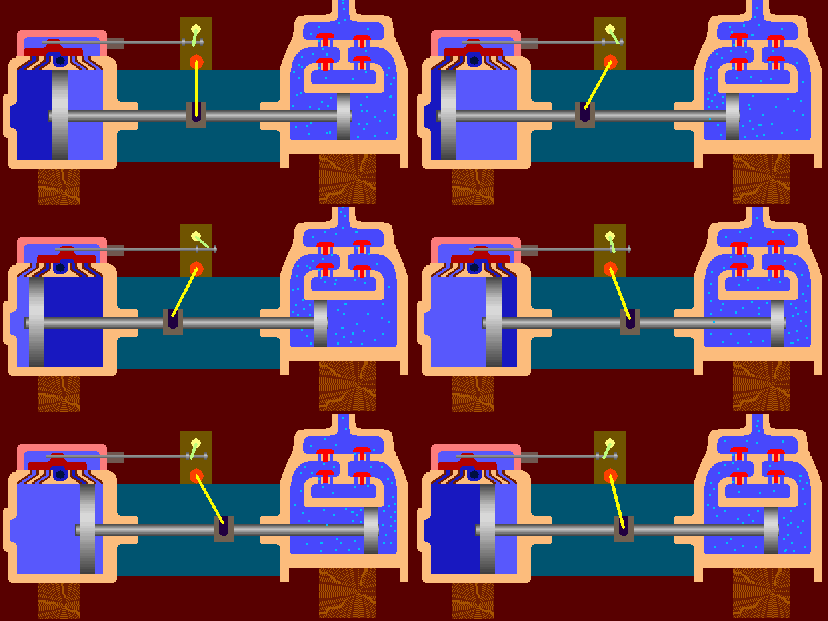
According to the displacement principle the hydraulic pump operates. In this principle the existed mechanically sealed chambers in the pump may involves. The purpose of these chambers is to transport the fluid from suction port (inlet) of the pump to the pressure port (outlet). These sealed chambers also ensure that no direct connection between the inlet and outlet port of the pump. This is the main reason that these pump suitable to operate at very high pressure and they are also ideal for Hydraulic systems. The mechanism of pump is shown in the figure below:


Mechanism of a pump

Types of Hydraulic Pumps

Depending on their different functional and other system requirements such as range of pressure or flow, operating medium, type of drive etc. hydraulic pumps are manufactured. Hydraulic pumps may have large range of design principle and configurations. All pumps can’t fully meet the requirements of the system. So for that reason different types of hydraulic pumps exists which are given below:

Hydraulic Gear Pumps

External gear pump
Internal gear pump
Gear ring pump
Screw spindle pump

Hydraulic Vane Pumps

Single chamber vane pump
Double chamber vane pump

Hydraulic Piston Pumps

Axial piston pump
Radial piston pump

Uses of Hydraulic Pumps

Hydraulic pumps are used in hydraulic machines. While selecting a hydraulic pump it must have good frequency, pressure and temperature capabilities. Hydraulic pumps are used to do different type of works such as open, close, lower and to lift components.They are also used in field services like machining and assortment of construction

A pump produces liquid flow or movement which is necessary for the development of pressure. This is a function of resistance to fluid flow in the system. For example, the pressure of the fluid at the pump outlet is zero for a pump not connected to a system (load). Further, to overcome the resistance of the load, pressure will rise to the level for a pump delivering into the system.


For more information about field services and hydraulics machines you can visit http://millenniumind.com/

Thursday, 7 May 2015

Shielded Metal Arc Welding (SMAW)

SMAW is a process of welding that uses a fragile electrode coated in flux. SMAW have many names this process is also known as stick welding, Manual Arc Welding or flux shielded arc welding. In SMAW process as the weld is laid, the external coating of flux on electrode disintegrates, providing a layer of slag and a shielding gas. These elements protect the weld area from infectivity until the area cools. The external flux coating also performs more functions such as it provides control bead shape or arc stability.

Equipment & Operation for SMAW

The following equipment and operations are necessary for SMAW process.
  • Welding power source
  •  Electrode holder
  • Ground clamp
  • Welding cables and connectors
  • Accessory equipment (It includes wire brush, chipping hammer)
  • Protective equipment (It includes gloves, helmet etc.)

Welding Power Sources

Shielded Metal Arc Welding circuit we can use either Direct Current (DC) or either Alternating Current. In some specific cases, the power source must use constant current type. In this type, power source will deliver relative welding current or constant amperage. As it will remains constant so the weld beads which are produced will be uniform in shape and size.


Electrode Holder

The use of electrode holder is to connect different welding cables and ducts to the electrode. Electrode holder is available in different sizes and capacities. The purpose of insulated handle is to guide electrode over the weld joints.

Ground Clamp

The purpose of the ground clamp is to connect the ground cable to the work piece. A good ground clamp having the characteristics of carrying more electric current without overheating.

Welding cables and connectors

Electrode cable and ground cable plays an important role in the SMAW circuit. So different welding cables and connectors are also necessary components for the SMAW circuit.

Coated Electrodes

In Shielded Metal Arc Welding various types of coated electrodes are used. For different types of welding specific electrodes are used according to their types. For example, electrodes used for low allows and stainless steels will quite different from the coated electrodes which are used for mild or carbon steel.

For information about the Fabrication or welding you can also visit http://millenniumind.com/

Wednesday, 29 April 2015

What Is CNC Machine, Types & Troubleshooting?

The word CNC is the derivation of NC meaning ‘Numerical Control’, whereas CNC means ‘Computer Numerical Control’. Obviously, CNC is numerically controlled device attached with the element of digital computing. In order to do so, machine tools are controlled by means of computer instructions, which are predetermined to perform each function of machine. Punched Tape is the clear example of machined controlled by computing device.

Overview:
Both NC & CNC enables greater ratio of productivity for tools of machine, as they are automatically controllable and require less human intervention. Before the innovation of CNC, Hydraulic Tracer Systems were less capable of automation element, due to the usage of hydraulics in cutting tools of lathe & template of mill. Moreover, such systems require taper attachments, which were used for many manual lathes indifferently capable of hydraulic tracer, as tracer had greater capability for the elaboration of templates rather than simple tapers.

Classification of CNC Machines:
As CNC involves usage of computers, so it increases the no. of machines, which could be brought under such classification.

  • Retrofitted Machines – The machines that don’t have CNC installed by default or during manufacture.
  • Custom Built Machines – The custom-built machines to perform CNC operation.

Types of CNC Machines:
Here we will mention some of the widely used at industrial level:

Milling Machine:
Milling Machine is used to cut different materials driven by computer controls, which translates programs containing instructions in the form of digits and letters to move the spindle of machine at specified dimensions. The standard programming language of all CNC machines is G code, while some manufacturers use customized propriety languages, which are simpler than standard language & easy in transfer.

Lathe Machine:
Lathe is a retrofitted CNC machine mostly used for cutting metal objects rotating with a fast speed. Basic feature of Lathe Machines is that they are capable to cut the metal by the help of indexable tools & drills with extreme precision in a quick manner that is not possible on manual lathes. Usually machine comprise of twelve tool holders, along with coolant pumps that cut down on tool wear. The field installation & control specification of Lathe Machine is similar to Milling Machine as it allows G code as well as proprietary programming language.

Troubleshooting of CNC Machine:
To troubleshoot a CNC machine, here are the key steps to follow:

  • Environmental Issue: The issue may arise due to increase in temperature. Temperature of machining shop should be maintained with respective measures.
  • Mechanical Issue: The problem may exist in flatbed guideway, ballscrews, & spindles that affect the tools and job under machine.
  • Electrical Issue: At major level, it could be heating of cable, or it could be at miniature level that could be traced by trained CNC engineer through milling machine schematics.

Tuesday, 21 April 2015

Fabrication classes


Fabrication classes
Fabrication classes

Metal fabrication shops includes many processes of producing metal elements by ever-changing the raw metal material exploitation varied tools. The processes are classified as cold, heat and hot operating betting on the temperature at that the fabric is processed. Most of the objects around USA like paper clips, computers, bolts, nails, automobile components, components used for instruments and machinery and myriad alternative merchandise are remodeled by metal fabrication processes like bending, punching, drilling, turning, grinding, threading etc. The factors influencing the method enclosed the kind of fabric being machined, the speed of production, the specified pure mathematics, and alternative physical needs of the half.

Fabrication is divided into the subsequent classes. 

Metal Forming:

• Bending: All through bending, the work piece is bent to make flanges, contours, curls, seams, corrugations and alternative geometries by means that of applying force through hydraulic, gas and electrical machines. 

Shearing
• Conventional shearing: cutting off could be a metal cutting method through that flat surfaces cut employing a scissors-like action, typically in straight lines.

• Turret Punching: Turret Punching creates shapes in sheet material by in turn punching a series of basic shapes. Edges are cut by the cutting off action of a punch and die.

Material Removal

• Sawing: Sawing could be a variety of cutting within which the cutting implement could be a blade that incorporates a series of teeth, with every tooth removing a tiny low quantity of fabric. Sawing is usually wont to form stuff to the approximate size of the half, before further processes. 

• Sound: Tapping produces internal threads within the work. This involves use of a tool with multiple cutting teeth.

• Boring: Boring produces circular internal profiles in hollow work or on a hole created by drilling or another method.

• Turning: Turning rotates the work concerning its axis whereas applying cutting tools to form a desired form.

• Drilling: Drilling produces holes in an exceedingly work employing a fluted cutting implement.

• Edge: Milling removes little chips employing a rotating cutter that moves in 3 axes. 

• Grinding: Grinding could be a chip removal method within which the cutting implement is associate abrasive grain wheel. Differing kinds of grinding embrace Surface grinding, Cylindrical grinding, Internal grinding and Center less grinding.

Advanced strategies

• Optical device cutting: Laser cutting involves focusing a beam of high density energy on the surface of the work. The beam evaporates parts of the work in an exceedingly controlled manner.

• Electro Discharge Machining: Electro discharge machining is predicated on erosion of metal by spark discharges. This method is used for machining associate material that is an electrical conductor. 

• Wire EDM: The wire EDM or Electro Discharge Machining produces half shapes by cutting a metal work piece with a endlessly moving wire by means that of fast, repetitive spark discharges.


This method is employed to chop skinny and thick metal and is commonly wont to create punches, tools and dies from laborious metals. 

• Water jet Cutting: during this method, the force of a water jet is employed to chop material. The water jet acts sort of a saw and cuts slim kerfs within the work. Most of metals, plastics, fabrics, wood merchandise, and rubber, building material, leather, brick and composite materials are cut exploitation the water jet method.